How I Meditated for 5 Hours Without Trying (The Importance of Offline Connection and Obliterating Social Anxiety)

I just returned home from a Super Bowl party on the Venice Canals, the most wonderfully stereotypical LA experience I’ve had to date: acai bowls and Impossible Burgers instead of your classic hot dog and burger BBQ, fully rapt attention for the halftime show and an utter disregard for the actual game (in fairness one woman asked me what the score was, and thankfully I was able to answer due to it being size 80 font at the bottom of the screen), and everyone I met was some form of an energy healer or life coach (and throw in your token tarot card reader as well – what a champ he was, straight-faced as all hell laying down nebulous cards on a table and spouting out life advice to people he’s never met before).

My conscious brain imploded trying to analyze and reason through the whole dynamic and colorful individuality of everyone so I just showed up as present as I could be and curiously inquired into everyone I met, each of them beautiful souls, charted pasts, and indeterminate futures.

Positive outcomes commenced:

I met a movement/stress coach who I think is the real deal – looking forward to one of his intro group sessions OUTSIDE.

I met a potential client for one of my businesses.

I met a couple of people I would love and have planned to see again.

People complimented my “energy” which I think means people like me.

Walking home 5 hours later after the game ended did it finally dawn on me that that was the longest I can recall in recent memory that I was almost entirely out of my own head and into the present moment; I was too busy listening and absorbing the event to focus on the me-monster inside me that dominates far too much of my existence. Dare I say it was the most live, laugh, love I’ve been in awhile.

People meditate and attempt to tap into mindfulness to escape their incessant stream of thoughts. There are functional ways to escape that notorious thought prison without having to sit yourself quietly until boredom soon triumphs. Show up to others with an open heart and blazing curiosity, and observe your social anxiety and the like melt away. Enjoy the brief respite from your own chattering mind and appreciate good things likely happening for you.

Note to self: find a way to tap into offline connection and relationships. I really think online should only be used as a tool to lead us back to as we say in my World of Warcraft days – IRL (in real life).

A diagram of the eight parts of an enneagram type.

How a BS, Woo-Woo Astrology App Changed My Life: The Pattern

Although I pray, admittedly for pragmatic reasons, I really consider science to be the most functional form of religion I have. And if I can’t explain something with valid backing, I find it hard to fully suspend or disable my disbelief. Of course, any person who fancies themself to be hyper-rational (a backdoor way to claim you’re smart) says this, but who’s counting.

That said, I am coming around to truly believe there are preternatural activities that defy all logic, science, and hope of rational explanation.

I’ve heard stories from people I trust, but I wasn’t there to observe and validate.

I’ve had a psychic predict things that happened in my life, but that could’ve been a self-fulfilling prophecy.

I’ve read wildy intricate and nuanced stories claiming the paranormal, but I don’t know the authors from Adam.

I’ve had someone I dated tell me she could feel my thoughts and mood, but maybe that’s an easy one to predict since I only have one speed: Go.

A spiritually savvy friend recommended I check out this app called The Pattern (free app – this is not a glorified advertisement). You plug in your date, place, and time of birth, and it gives you a full-blown panel of details about yourself: relationship and personal needs, tendencies, even destiny. I continued to read through mine and was equally impressed and bewildered by how accurate it was for me.

The standard knock on these type of horoscope things is that they are so generic that the answers could apply to anyone, and hell, that’s likely the case. But at the same time…

Some people are driven by freedom and independence (i.e. me) more than significance and validation.

Some people need a slightly codependent person in a romantic relationship to feel wanted, whereas others, like me, need someone who damn near forgets their significant other altogether, being so independent and self-sufficient (okay, a bit extreme, but it seems favorable to the other end of someone being ultra clingy).

Some people have a natural sense of peace and harmony whereas others are inherently restless, constantly searching for the next thing to throw themselves mentally or physically into (me again, sorry).

As it were, they nailed my personality and temperament better than I’ve been able to articulate it myself, which is one of the most valuable aspects from going through this exercise – assuming it works for you too.

So getting down to brass tacks (do people still use that idiomatic expression?) let’s explore how it impacted my life.

Again, first and foremost, it feels good to feel understood. We all want to feel seen and heard, which is why I chose to be large and loud. You gain confidence in yourself and your ability to lean into who you really are. Do you, boo.

Due to my inordinately high drive for freedom, I am no longer considering golden handcuff corporate jobs that I had in the back of my mind. One more decision/mental open loop put to bed. Conversely, I am weighing new opportunities almost strictly through the lense of pulling me into less or more freedom, autonomy, and independence.

Lastly, The Pattern helped me see something that in hindsight should’ve been painfully obvious. I don’t do well with codependent friends or people. The more you push on me for attention or affection, the less you’ll get from me. I never thought to apply this to romantic relationships as well, but it’s now clear I need a partner who is highly independent, so we both can pursue our interests and ambitions unencumbered, and come together to enhance each other’s lives on our own free will. No conventions. No societal/conformity obligations. Just two people showing up for each other when it mutually makes sense.

Now if you’ll excuse me, I have to call someone. She hasn’t texted me back and it’s driving me nuts, so I’ll persist and up my communication until she hangs out with me. (The sad part is I have actually been in this situation several times, so maybe I simply have no clue who I am, but it felt really good for a moment to fit me into a recognizable box. Thanks, The Pattern). 

A drawing of a person and two people with arrows pointing to the center.

Two Human Operating Models You Live Your Life By Without Even Knowing It (Probably): Solving Problems vs. Seeking Validation

To be human is interesting, to say the least. We do things for reasons even we don’t understand (Thinking Fast and Slow, cognitive biases, Influence by Robert Cialdini, etc.). Let’s boil it down to two fundamental drivers of essentially all human decisions and actions. Without this realization and understanding, you will be very confused by the world. And, you will be confused anyway, so let’s do what we can to lessen the load every so slightly.

Those Who Solve Problems (aka Pragmatists, “Reasonable” People, People Brian Respects, 0-1% of Instagram Influencers)

These are people who speak when spoken to, or to otherwise resolve something at hand. They value functionality over image, status, or prestige. They drive Toyotas, or Teslas if they want to double-dip operating models which we will get to shortly. You may hear them say they don’t like “talking.” If less will do, less is the way. They live their life solving one problem to the next, without given excessive thought to how things will be perceived, or even if they will be, by others. Pretty simple and end of story, so let’s get into the next human operating model.

Those Who Seek Validation (aka Me-Monsters, Attention Who-err-Grabbers, People Who Talk About Being Woke or Enlightened, Most People)

I’ll never forget walking into my first Farmer’s Market in Santa Monica, witnessing every female wearing Alo pants. I remember the good ol‘ days when Luluemon was the attire to be had, but oh how fashion changes promptly and without exception. One of the reason’s I hate fashion is marketers have it down to a science to continually change what is considered in and chic, pushing the consumer to make a decision to cave and purchase, or tacitly take a stand. If you choose to fit in then you are seeking validation, which is understandable given we are socially wired to connect else we risk being ostracized from the tribe, where we then have to go out and look for berries and twigs and fend for ourselves, but we aren’t equipped to do so because it’s cold outside and there’s no “I” in team, so we would starve and die (sorry, I had to offer yet another overblown explanation of social creatures and tribes from someone who’s never read a book on evolution).

If everyone has a Rolex or a Ferrari, then it no longer signals to others that you are inherently better than everyone else and god’s gift to mankind. This is known as a zero-sum game, where if someone wins it means someone necessarily loses (Naval Ravikant talks about this more eloquently). There is no justifiable purpose or function of things like Rolexes or Ferraris, other than to signal to others, seeking validation. Can’t you just validate yourself, gosh darn it! No, you need to flaunt around, find ways to re-direct the conversation back to you, humble or full-on brag, or otherwise find ways to showboat. That all ends today! (not really, this has been going on forever and will continue to do so – I listened to an entire lecture in Charleson on how silk was worn explicitly to status-signal back in the day).

—-

Admittedly most of us fall into both of these camps, but usually one is much more dominant than the other. What would you do if no one could find out and you could never post about it on social media? Asking this question to a validation seeking dominant person is like asking…nevermind I overestimated my analogy producing abilities – stupid is as stupid does. Awareness of your balance or lack thereof here, as with most things, is usually a constructive first step. The next step is to continually assess your actions and decisions through this lense and ask yourself if that’s acceptable to you. If you’re anything like me (then god help you), you minimize the validation-seeking game and instead harness your energies into productive and problem-solving means.

At age 20, we worry about what others think of us. At age 40, we don’t care what they think of us. At age 60, we discover they haven’t been thinking of us at all.

You get one shot in life, as best we know it. Don’t blow it by building up a house-of-cards life to impress people you don’t like to begin with.

My idea of the modern Stoic sage is someone who transforms fear into prudence, pain into information, mistakes into initiation, and desire into undertaking.

Antifragile by Nassim Nicholas Taleb

A group of people are connected to each other.

Why Group Conversations Suck (The Value of Introspection & Finding Your Tribe)

Do I want to go to my high school reunion? Not really. Nor do I desire to return to the annual Christmas party with an old batch of high school friends. This HS jock is going AWOL. You heard me girl. 

Groups and their pertaining conversations if you can call them that suffer from what I refer to as the lowest common denominator syndrome. The discussion reliably and without exception falls to the lowest level for all present to bear, versus rising to the greatest possible heights to serve and delight the most well-armed and educated of the bunch. Less pedantically, I sit there bored at dinner while my buddy swaps high school yet elementary tidbits with his friend while I pick at my plantain chips scooping up the last atom of avocado dip before I’m socially coerced into sharing. 

Groups magnify interpersonal influence. If you are the one person who opposes the proposed plans or ideas, you face exponential pressure from the group, usually fueled by a ring leader. Entire social experiments and studies have validated the conformity bias which formally states that if everyone in the room is dead-fing-wrong you must promptly follow suit without question. Yes sir. Thank you sir. Will that be all, sir? Peer pressure is just the beginning of it here.

The classic introvert will thrive in one-on-one discussions and flail in groups. Deviating from this successfully for any period of time comes at an enormous psychological expense. Lean into who you are and apologize not. In the process, you’ll attain oodles of respect. Sure you may lose an iota of popularity but who’s counting and who cares.

If you wish to have volition over your life, and inner locus of control — a non-negotiable for personal happiness and well-being — then do your thinking independently and introspect in isolation. Examine your life and live that life well lived. The more valuable meta-learning with this post’s cogent argument (if I say so myself, unbiased as can be) is to have confidence in yourself and your operating systems. If you KNOW you won’t enjoy yourself at the event, don’t feel compelled to do so (all else equal). Life is too short to get bullied and pushed into things that are not in alignment with who you are. Alas, there is an opportunity cost with every action and decision you make. Life is finite, so don’t blow it quietly pouting in a corner.

If you think you are the only person with such esoteric behavior as avoiding annual get-togethers with people you are luke-warm on at best, then I implore you to keep searching for your tribe or positive plus one. Introduce yourself and be friendly with everyone. Experiment with new classes, events, living situations, locations, etc. Explore and expand into yourself; your vibe attracts your tribe, as they say. Now if you’ll excuse me, I have to RSVP to a Christmas party.

3 Biohacks To Physically Exercise Your Way Into Mental Brilliance

I love double-dipping and stacking health benefits; anything that smells of efficiency thoroughly excites me. Examples include getting vitamin D while forest bathing or walking in nature, or perhaps you fancy a meditative trance while walking. We live in an age where brains are valued over brawn, so anything that enhances mental clarity and cognitive performance is worth its weight in gold. Instead of cheesy tricks to remember people’s names (which I also need) let’s review some exercises you can do to literally change your brain. Each of these biohacks is beneficial as a standalone fitness exercise, so use the knowledge of their brain-boosting benefits as further motivation (or vice versa, depending on your values, either way you get both).

Biohack #1: Handstands

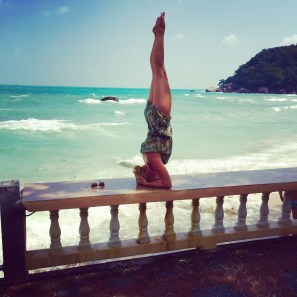
Free, fun, no equipment required, with infinite progressions, handstands are a dream come true. They offer a full swath of fitness-related benefits, but inverting your body rushes blood into your brain, building new capillaries, making it easier to get blood to your brain, which increases oxygen uptake and mental performance. Handstands also stimulate the pituitary and pineal glands, vital for hormone and body balance. Inversion tables will have the same brain blood flow benefits, but they are the clunky, expensive, lazy way to accomplish what a handstand can do (parallel to the free weight versus machine argument in the gym).

handstands, yoga

Biohack #2: Juggling

Juggling won’t tax your nervous system and fatigue you the way other exercises will, yet they offer a potent brain upgrade. Juggling enhances connections in the brain by changing the white matter (provides the electrical circuitry to connect disparate parts of the brain, sharpening concentration and enabling one of the greatest manifestations of intelligence: connecting disparate phenomena). Learning any new skill can trigger these changes, but juggling is the most universally studied and accessible to anyone. Reason #99 to never stop learning.

Biohack #3: Aerobic Exercise

This one was actually a bit disheartening to learn since I don’t sit comfortably knowing there’s an exceptionally compelling reason why I should be running more. Ignorance is bliss; I was happy just doing my high-intensity workouts, but the goal of life is to continually expand your Bounded Rationality. Sustained (20 minutes or more) aerobic exercise has been shown to stimulate neurogenesis in the hippocampus (improves learning ability). You can literally jog yourself into growing new brain cells. If that isn’t better living through science, I don’t know what is.

You now have the brain boost trifecta: increasing blood flow from handstands, increase white matter and effectively brain power from juggling, and increasing total neurons from aerobic exercise. You’re getting more gas pumped into the engine, a more efficient engine, and a bigger engine. I don’t give a @#$% about cars but (wo)man am I excited, and that’s what this article is all about!

A graph of the frequency of monitoring things.

Why I Stopped Checking My Oura Ring Every Day (& How to Prevent Tech From Destroying Your Life)

If you’re not familiar, the Oura Ring is a wearable that tracks health variables and biometrics like heart rate variability (HRV), steps, REM and deep sleep, etc. I bought it explicitly for sleep tracking as nothing throws me off course faster than poor sleep; I wake up after a terrible night’s sleep looking for the “skip” button for my entire day.

How fun is it for an obsessive personality to wake up every morning and get REAL-TIME feedback on how you did? Doing this daily provides the illusion of control when in reality you can’t do anything to change your previous night’s sleep or actions leading up to it. Further, you probably shouldn’t make future decisions based on a single day or point of data. Checking the app every morning became a chew toy for me until I gnawed off my hand in the process.

People like me take the phrase, “In God we trust, all else bring data,” a little too seriously; you start to feel more tired because your Oura Ring app tells you as much. The counterproductive effects of stressing about your poor or imperfect (for an optimizer) sleep are too much to bear; I love nothing more than buying a health gadget that makes me less healthy because then I can hit the trifecta of being dumb, out 400 bucks, and more anxious.

Use the tool, don’t let the tool use you. I now put the Oura Ring on airplane mode (which has the added bonus of mitigating Bluetooth EMF exposure) and check it once a week to reflect on my week and most importantly check the Trends section of how I am doing week-over-week. Getting a longer-range view allows you to make more educated and less impulsive decisions. You can then decide one or two variables to improve upon, maybe as simple as going to bed earlier. Better decisions, less intra-week stress about daily performance (together which is formally known as ‘more better’).

This logic of signal over the noise applies to almost everything and I stopped checking the stock market daily for the same reason to avoid hyper-reactive decisions and emotions. The trends through time tell the truest tale (alliteration for the win, and the acronym TTTTTTTTTTT).

Some examples and personal observations of over-biasing monitoring over intelligently managing:

  • Checking Oura Ring daily = Feel more tired = Negative placebo effect
  • Checking stock market daily = Tempted to or actually make impulsive decisions that are statistically proven to yield poorer financial performance over time than if you dollar-cost averaged your way in or had an otherwise systematic approach + Wasted decision fatigue and time + Ability to comment on the markets to sound smarter than you are and impress people you don’t like anyway
  • Checking Instagram daily = Get fewer things done that would make you worthy of posting anything interesting on Instagram to begin with + Surreptitiously start to feel less adequate about yourself comparing your low-lights to everyone else’s stratospheric highlights
  • Checking Hinge daily = false sense of hope watching grenades “like” you
  • Checking Facebook daily = watch my two conspiracy theorists friends ramble into the outer orbit of fact-hood
  • Checking the news daily = I’m not even going to bother explaining this one if you made it this far

Pro tip: Don’t rely on willpower to avoid checking things, but rather distance yourself by using airplane mode or deleting the apps; if you don’t want to slip, don’t go where it’s slippery. 

Control what you can and leave the rest.

Be proactive instead of reactive.

Opt for productivity over busyness.

“Avoid the crowd. Do your own thinking independently. Be the chess player, not the chess piece.”

“• Ralph Charell

Now if you’ll excuse me, my phone just vibrated.

Scroll to Top